Look at the picture
The timer runs for 30 seconds.
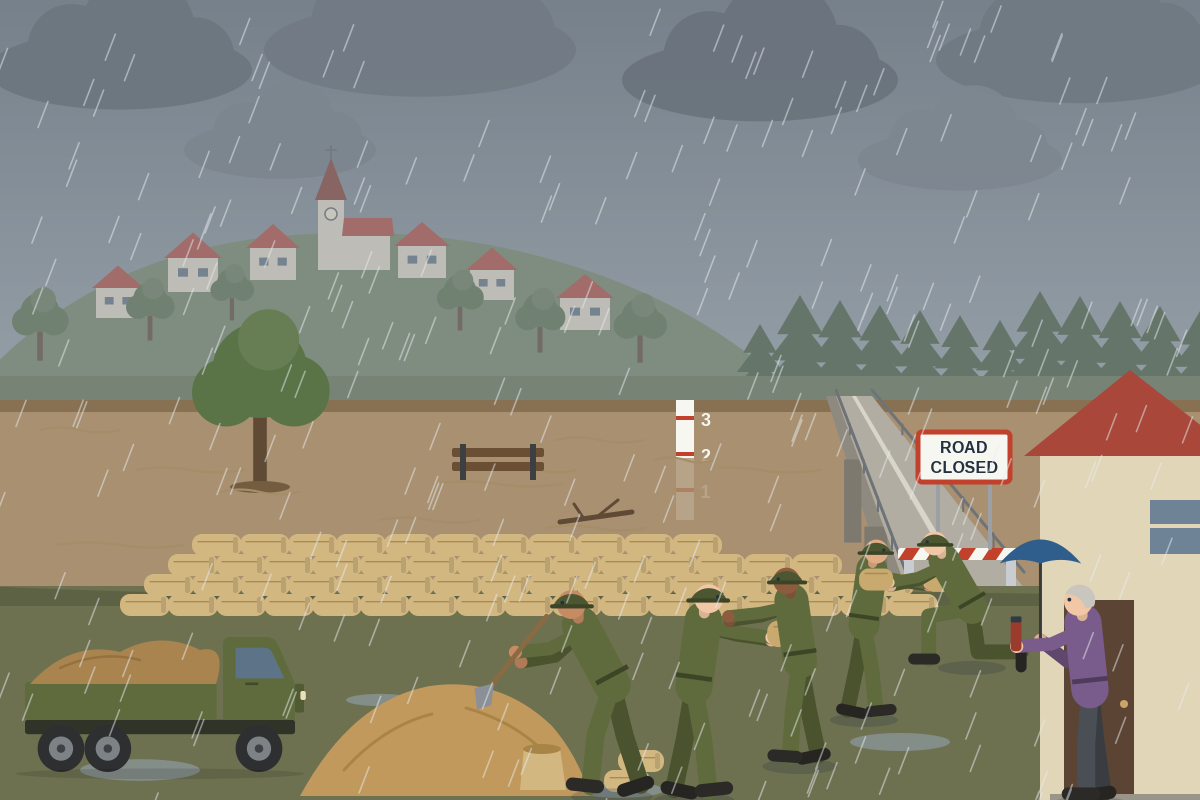
RecordingSoldiers are building a wall of sandbags because the river is flooding.
Get ready to speak
Words for this picture
The four parts of a description
Where is it? When? What is the weather like?
- This picture shows ...
- It looks like ...
- It is a sunny / rainy / cold day.
Who can you see? What are they doing?
- There are three soldiers.
- One of them is ...ing.
- Another one is ...ing.
What else can you see, and where?
- On the left / On the right, there is ...
- In the foreground / In the background ...
- Next to / Behind / In front of ...
What do you think is happening? What happened before? What will happen next?
- I think ... because ...
- Maybe they ... / They might ...
- Next, they will probably ...
Why: because, so, to. To give reasons and to say what something is for.
They are building a wall to stop the water. It is raining, so the river is high.
Four sentences about this picture. Tap the right words. Then use them when you speak.
1. They are building a wall ___ stop the water.
2. It is raining hard, ___ the river is very high.
3. The road is closed ___ the flood.
4. The woman is holding out a thermos ___ the soldiers are cold and wet.
Describe the picture
1 The whole picture2 The people3 The details4 Your ideas
The timer runs for 2 minutes.
RecordingYour recording. Listen and count: how many of the four parts did you use? It is gone when you leave this page.
No word? Explain it: "the thing you use to ...", "a kind of ...". Stuck? Go to the next part.
Stuck? Questions to help you
- What is the weather like?
- What are the soldiers doing?
- What can you see in the river?
- Who do you think the woman on the right is?
Answer the questions
- Tell me how the soldiers are working together.
The soldiers are working in a line. One is filling bags with sand, the others are passing the bags from hand to hand, and the last one is putting them on the wall.
- What do you think happened in this village in the last few days?
I think it rained for days, so the river rose and the water came into the village. Then the soldiers arrived with a truck of sand.
- What will happen if the rain does not stop?
If the rain does not stop, the river will rise even higher. The water might come over the sandbag wall, and the people in the houses will have to leave.
- Have you ever helped people after a storm, a flood or a fire? What did you do?
- Why do you think the woman is holding a thermos?
I think the woman is holding the thermos because the soldiers are cold and wet. She wants to give them a hot drink and say thank you.
- Harder: Soldiers often help when there is a flood or a fire. Do you think this is a good job for soldiers? Why, or why not?
Asking the questions? Ask one at a time. If an answer is short, ask "Why?" or "Tell me more."
Say it again
Phrases from the model. After you speak: did you use them?
The timer runs for 1 minute.
RecordingYour first talk (2:00), to compare:
Your recording. Listen and count: how many of the four parts did you use? It is gone when you leave this page.
One thing I liked:
- you kept going
- you said where things are
- you gave a reason with because
- you used the four parts
Next time, try:
- say what you think, with "I think ... because"
- use is plus -ing for actions
- say what happened before
- explain a word you do not know
With a partner? Change roles: now you listen and ask the questions.